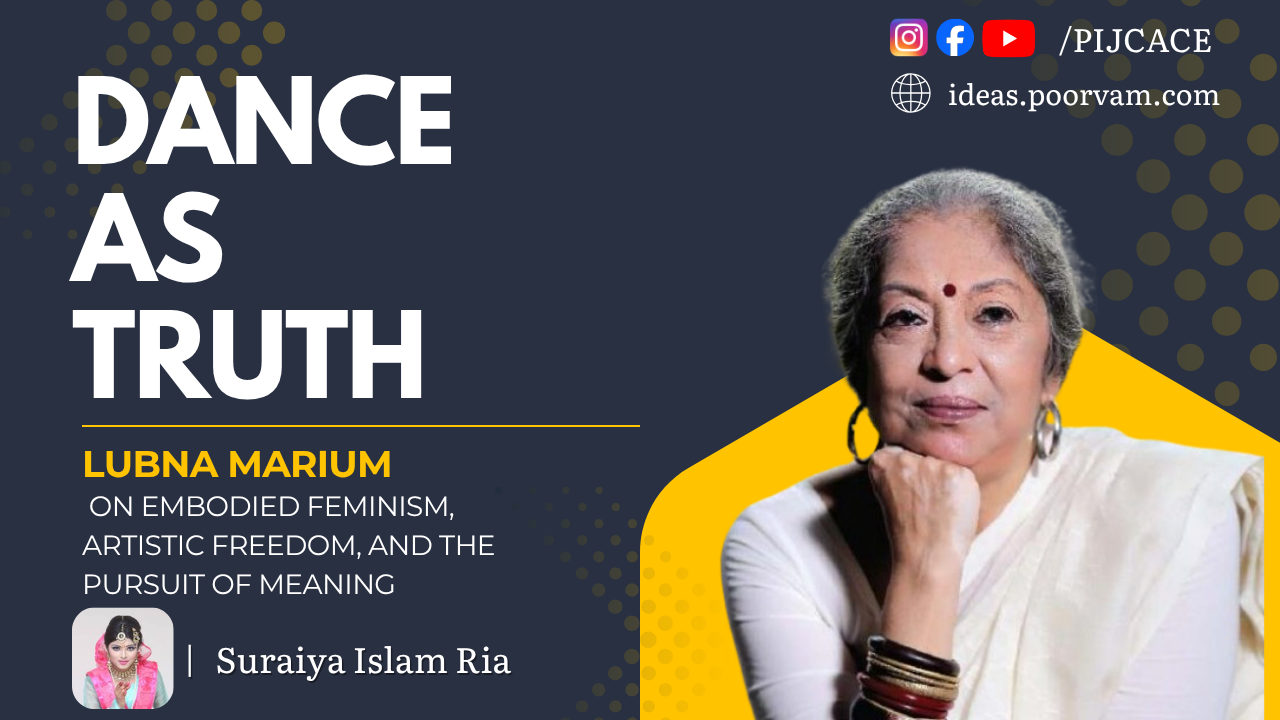
Your new project “Embodied Feminism” — can you tell us about it? What need prompted you to take up this initiative?
The project is targeted towards dancers. The idea is for dancers to expand their practice and think about the fact that dance is an extremely powerful medium. Not just powerful — people want to watch dance. It is attractive. And if through dance we can put forward a powerful statement, bring about some change in society, empower women — why not? Akram Khan's productions, for instance, are extremely powerful.
Of course we use dance in religious festivals, we can dance to mark the changing seasons — but why not use it as a vehicle for powerful messages? Of course we respect Kathak, Bharatanatyam, the classical forms that have always been practiced — but let us try to see if through dance we can bring about social change.
What outcomes are you hoping for from this project?
My target is dancers. Fifty-six people have applied; my budget is for twenty, but I am going to try to accommodate all fifty-six, because this is about outreach. If I can convince fifty-six people that through dance they can conve y adifferent kind of powerful statement before society — why not? Yes, fine, we danced the Radha dance, we danced the Krishna dance, there is meaning in those too. But somehow those get overshadowed by religious belief. So if we set that aside and place a purely social statement within the dance — why not? Let us see, let us try.
Have you faced any obstacles in doing this project so far?
Never. Who is going to obstruct it? Who has the courage? I am not doing anything wrong — I do not think so. If literature can make a powerful statement, if theatre can, why cannot dance? This is my dialogue with my dancers. The target is the dancers. I am asking them: question yourself — why are you practicing dance? I am asking you too: what is the purpose of your dance practice? It is a big question! Is it to become a celebrity? To make a social statement? To express philosophical thought?
For example, we produced Dilnawaz. In Dilnawaz we used the Sama. They are meditating, turning and turning, meditating through that whirling motion. What are they trying to say? Their body has the power to achieve truth. Do you believe that? I do! What have you found through your dance? You have to ask yourself. And in our subcontinent we believe the mind is not only in the head — the chakras run through the entire body, do they not? Each chakra — it is invigorated.
[Translator's note: Sama is the Sufi whirling ceremony used as a form of moving meditation; also rendered as Sema in Turkish usage.]
If you realise there is more to life than who said what today, who gossiped about what — none of that matters. Your highest chakra is above your head. Who are you interacting with? Is there another power? You have to ask yourself. These are small efforts, nothing too grand.
There is a view that performing arts presentations in Bangladesh have largely shut down, and practice has declined as a result. How do you see this situation?
I disagree. Practice has not declined here at all — it is happening everywhere. In fact, from our organisation specifically, we have doubled our output. Because this kind of talk is going around, to prove otherwise, we are performing shows at the Shilpakala every two months, we are presenting Dilnawaz, we are conducting workshops — I do not see any shortage anywhere. These are all political slogans. You should not take them to heart. It depends on me. Nobody has ever stopped us. We work at the Shilpakala, and the Shilpakala is a public space where everyone comes.
Yes, there is some fundamentalist thinking — since fundamentalist groups are gaining political space, they can voice their positions more loudly. It is up to me whether I listen to them, whether I am frightened by them. One thing you must remember: the people of East Bengal are deeply pluralistic when it comes to belief. People pray five times a day and worship Manasa; they pray five times a day and perform the Bon Bibi puja. Much of greater India does not understand this. In a land where someone like Lalon was born, where Lalon commands such deep reverence and is so widely practiced — the arts can never be shut down there.
In your view, is art entirely career-driven? Because what I observe in the current situation is that with the change of government, the volume of events has visibly dropped. So are artists practicing art purely for career purposes?
Let me speak from my own life. Before I was twenty-five or twenty-six, I had no idea that you could earn money from dance practice. I had no concept of it, because we grew up through the Language Movement, through a cultural movement. Wherever and whenever protest was needed, we danced. We protested through dance. The question of money did not arise there at all. But yes — when I learned that you could earn a living through art, I was not unhappy about it. Because all forms of labour deserve dignity — why should they not? If you can earn five taka selling a couple of biscuits, then why should someone who has dedicated years of practice to creating a performance not be paid for it?
And let me say one more thing: every form of art, every kind of practice, has multiple paths. Art can be commercial, art can be for art's sake, art can be for religious purposes. Which path I choose is up to me.
Take the recent controversy over Arthy receiving the Ekushey Padak. Arthy used her art practice, her dance practice, to serve a particular community of people who wanted to engage with art for mental peace — for them, artistic excellence was not the primary goal. But the peace and joy they found through dance practice, Arthy facilitated that for them. That is seeing art practice through a different lens. I admired it enormously, because it had never occurred to me.
Art as a space for soothing, art as a space for relaxation — if the government chooses to recognise that, then of course it will award it, a hundred times over. That is the government's decision. The title belongs to the government — it is their recognition. I say this because I believe in different journeys. Someone dances in Bollywood, someone dances in nightclubs, someone practices purely for inner artistic development, training day and night for classical performance. It is my choice — I have that freedom.
And yes, you are saying that arts activity in government-sponsored events has become less visible — we are concerned about that too. A new government has just been formed; let us see which direction they go. We are not disempowered — we are empowered. If I want to dance, who is going to stop me? My organisation Shadhona has never, in twenty-five to thirty years, done a single government-sponsored event — yet we do the most events of anyone. I am empowered and I will continue. If I have the will to do it, who are you to stop it? Nobody can stop it. To this day nobody has tried, nobody has had the courage.
As a performing artist, do you transcend religious thought in embracing art? There is a sense that performing arts has its own dharma — the dharma of the dancer, natadharma. How do you see this?
My answer is the same. My aim is the same. Religion is bringing me to truth; my art practice is bringing me to truth. Now what is my aim in religious practice? Whatever creates social division — 'this is your God, this is my Allah' — for me there is no difference. Whether you worship Durga, Nataraja, or place your faith in the mantras of Shiva — to me all of these are symbols of truth. Each society, each culture, each era has created its own symbols of truth. Shiva is truth; Allah is equally truth. These are each symbols. What does the human being want? Peace. A broader social unity. There is an anticipation ahead. The Quran could not have come in Sanskrit in the Arab world — in the Arab world it came in Arabic, in that form — but the aim is the same. That is why art practice never feels like a contradiction to me. It depends on the individual. What am I seeking? What is my aim? What do I gain from praying five times a day, or from practising Manipuri or Bharatanatyam? It is up to me.
From what I know of you personally, you know Sanskrit. Why did you become interested in learning it, and how do you see its necessity?
I am fundamentally a reader. I read a great deal — all kinds of books. English, Bengali, fiction, poetry, essays. I read essays voraciously. And we came of age during the Language Movement. Rabindranath was a tremendous pillar of that movement, of the Bengali Language Movement. In all our protest gatherings, we were singing Rabindra Sangeet, dancing to Rabindra Sangeet — so from childhood my sister and I would sit and compete over the Gitabitan. We would open a page and see who knew more songs. I knew most of them. That was the place Rabindranath held for us.
Among Rabindranath's stories, poems, and songs, what I loved most were his essays — and in his essays he constantly cites the Upanishads. That sparked enormous curiosity in me: what are these texts, what is this language? Then, after some years, after I began studying dance, I encountered the Natyashastra. After reading Manomohan Ghosh's translation of the Natyashastra, I thought — let me learn this language. I was fortunate enough to study under Radhavallabh Tripathi, who is a great Natyashastra scholar. And to study the Natyashastra, you have to know Abhinavagupta — he is the foremost commentator. To know Abhinavagupta, you have to know Kashmir Shaivism. To understand Kashmir Shaivism, you have to understand two streams of thought: the Vedic and the Tantric. The Vedic is one stream; the other is the Agamic, which is the Tantric. The Agamas are all the texts of Tantra. After becoming more closely acquainted with Tantra through Agamic philosophy, I wanted to find where Agamic thought exists in Bangladesh. In Buddhist thought — specifically Tantric Buddhist thought, and in particular Vajrayana.
Which is a foundational thought of East Bengal. We should feel proud that such beautiful, such profound philosophical thinking took place here. That is why I have wanted to know Sanskrit from a young age, and why I read it.
How do religion and art support each other, and how do they sometimes come into conflict? Sanskrit, for instance, speaks primarily of Sanatana philosophy — how do you view this as a person of a different faith, and how might others view it?
There is a complex relationship between artistic practice and religious practice. Across many eras we see that religion and religious thought often inspire artistic endeavours — but when an artist or their work questions religious thought, that is when conflict arises. Take Salman Rushdie's The Satanic Verses — that is a work of art, a work of literature. But it questioned religion, and that is when conflict was created.
Now, I believe conflict arises when a gap opens up between the aim of art and the aim of religion. For me, the aim of religion is to reach truth. Art has the same aim. If my aim is the same, conflict does not arise. But there are certainly differences in how people interpret and practice religion — depending on the era you are speaking of, the country, the political context in which religion is being used. But fundamentally, at its core, I do not think so.
Children come to learn dance from me, and their parents ask: can we practice dance during Ramadan? Should we stop dancing when the azan sounds? Why would Muslim boys and girls perform guru vandana? And I always say: I see no contradiction. Why would I not perform guru vandana? My religion has never told me not to respect my teacher. Whatever language it is in, these are all symbols — at its core it is simply reverence. Now if I can move beyond a literal interpretation and arrive at a broader one, you will see there is no contradiction at all. It truly depends on the individual. What is the purpose of my religious practice, and what is the purpose of my art practice? I believe that if both are trying to reach truth, then in that space there is no conflict at all.
Responses & Scholarly Discussion (0)
Moderated Forum